Wise Ones
The ChangelingThe Wise Ones are a community of women and children living on North Brother Island, where Cal offers refuge to women who have been disbelieved or left without help. To outsiders they appear as witches; within the story, that name gives way to a more concrete account of mutual support, guarded shelter, and determined action. Their community is tested when Apollo Kagwa arrives demanding revenge, and later when the group must evacuate under threat. Its defining strength is not a claim to supernatural power but the organized care through which its members protect one another and their children.
Identity and the name
Apollo first encounters the name through a woman describing how she sought help after her daughter was taken. When she says that Cal told her how to get the child back, Apollo reacts with alarm, fearing that she might kill her baby. Later, replaying the woman’s account, he asks William Wheeler whether he has heard of the Wise Ones. Wheeler finds a passage in a book describing one or two such figures in villages; the text identifies them as witches. The label gives Apollo a clue, but not yet an understanding of the people it names.
That gap between a received description and lived reality matters. Apollo initially treats the word as a disturbing clue in a mystery, and his response to it is dismissive. On North Brother Island, Cal acknowledges that people call the women witches, but offers another meaning: women can become capable of what seems impossible when they must save someone they love. Her account does not establish that the Wise Ones wield literal magic. Instead, it connects their apparent extraordinary power to acts of protection and endurance.
Refuge and the work of care
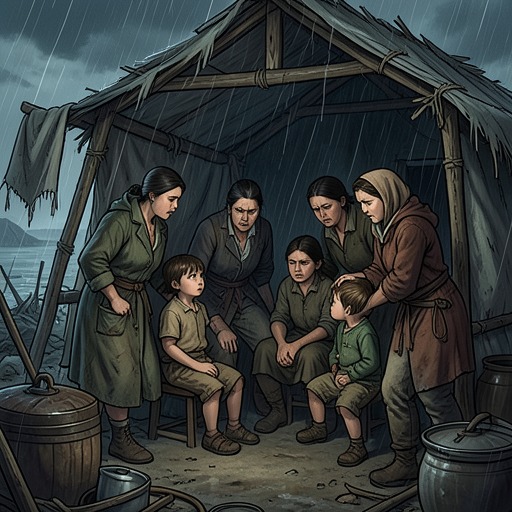
The Wise Ones’ community is made up of women and children who have returned to North Brother Island. They occupy the Nurses’ Residence rather than the island’s largest surviving building, the Tuberculosis Pavilion. The four-story residence, originally built to house 125 nurses, has lost its windows to the elements; the women repair the openings with clear plastic, and firelight shines through them. The Doctor’s Cottage stands nearby, its facade fallen. These abandoned institutional buildings become a base from which the community can live and regroup.
Cal describes the refuge as a place for women who arrive bereft and confused, where they will be believed rather than second-guessed or told that their experience is not real. She does not demand that anyone remain. Some women leave, she says, but each leaves stronger than when she arrived. The principle is visible in the woman Apollo first hears: after Gary responds to the loss of her daughter by telling her to take medication and calling her a crazy bitch, she seeks help among mothers instead. Cal gives her advice about getting her daughter back, although the woman remains unsure whether she can carry it out. The Wise Ones’ support is therefore more than shelter: it gives women a place to be heard and a basis for acting.
The refuge also exists in an uneasy relation to the world beyond the island. Apollo is astonished that this settlement lies less than four miles from his apartment, yet seems like a village hidden in wilderness. The island’s apparent remoteness is not geographical isolation from New York City so much as a break from ordinary visibility and expectation. Even the black-crowned night herons, which had occupied the island for more than two decades after its institutional uses ended, have left; Apollo understands that the returning women and children have displaced them.
Defense and Apollo’s arrival
The Wise Ones’ welcome is guarded because Apollo does not arrive as a neutral visitor. He steps from the overgrowth shouting that he is the god Apollo and wants revenge. Four women appear carrying clubs made from chair legs, each fitted with a leather wrist strap. Their green cloaks blend into the island’s vegetation, making the woods seem to close around him. They attack with practiced restraint: rather than strike his head and knock him unconscious, they target his arms and legs, quickly making him unable to fight back. The encounter shows their readiness to incapacitate a perceived threat while controlling the risk of a prolonged struggle.
After the beating, the women search Apollo and find no phone. They do not comfort him or help him stand; instead, they tell him that Cal will want to see him and direct him along the path. They have caught Apollo but not William Wheeler, a distinction Apollo recognizes as he walks back under guard. The phone turns up later: it fell in the courtyard during the capture, and a child found it and brought it to Cal. Cal’s response, criticizing Apollo for not being careful, indicates that she has trained him before and that his careless handling of the phone is a lapse in an existing relationship, not a first lesson in her methods.
As the women escort him through the decaying School building toward Cal, Apollo remembers the mother’s uncertainty about whether she can do what Cal advised. A guard strikes his shoulder when he reacts sharply to the memory. The brief, painful reminder of his captivity sits beside the advice he is beginning to understand: the women’s care for one another does not mean they will make themselves vulnerable to him. His entry into their refuge is defined first by their assessment of danger, not by the revenge he has come to pursue.
Cal’s account of the community
Cal explains the Wise Ones to Apollo through the idea of an ugly fairy tale in which he and Emma Valentine have become involved. She insists that he cannot simply shut his eyes to what is happening. The man held in a cage consorts with monsters, and the women’s experience on the island has taught them to take that danger seriously. In this account, the word witches is neither simply denied nor accepted as a supernatural description: Cal turns it toward the extraordinary capacities people develop when ordinary protection fails.
Her account of Emma makes that idea specific. Cal has watched Emma paddle across the river in her creek boat, going back out to search for her son, and describes the sight as luminous. The image links the Wise Ones’ understanding of transformation to a mother’s repeated effort to reach a child, rather than to a formal spell or power. Cal presents love as the force behind such acts, while the community’s practical work—guarding, sheltering, and moving together—gives that force a collective form.
Evacuation and collective survival
When the Wise Ones leave the island, their discipline becomes visible on a larger scale. Women and children file out of the Nurses’ Residence carrying packs and bags; all but the youngest children carry something, while the smallest are carried. The infants are silent. Apollo cannot tell exactly how many people have survived, but he notices that the population seems reduced. Despite exhaustion and fear, the group moves in two orderly columns, with a level of coordination he compares to that of a Special Forces team.
Cal keeps Apollo silent when he is tempted to respond to Kinder Garten, who calls out that he is not a bad man and asks to explain himself. She slaps Apollo rather than let him reveal their position. He understands that speaking could expose the group, and that Cal would choose their safety over sparing him. The Wise Ones thread through the woods along a route Apollo could not have seen for himself, passing the coal storage house, foundry, chapel, morgue, and old gantry crane before reaching the ferry slip. The path through the island’s ruined infrastructure becomes an escape route because the women know how to move through it.
At the slip Apollo can finally count the community: nineteen women and eleven children. Gayl is half asleep in her mother’s arms, while her older brother leans against their mother’s hip, nearly asleep on his feet. A Pilgrim 40 Pilothouse Trawler appears from the dark water with a guard at the helm. The boarding order protects the children first: older children are helped aboard and sent below, then the infants are passed to them to carry to the forward master cabin, the ship’s most protected space. The women pass bags and supplies along the pier before boarding themselves. In eight minutes the group is ready to leave, though Cal, Apollo, and her twin guards remain on the dock for the moment.
The evacuation gives substance to Cal’s explanation of what people call magic. The children are not saved by a solitary hero or an unexplained power; their safety depends on practiced cooperation, divided responsibility, guarded routes, and a community able to move quickly under pressure. The Wise Ones’ story thus shifts the meaning of their name from a label found in a book to a demanding form of collective protection. Their refuge can be threatened, and its population may suffer losses, but its members meet danger through knowledge, order, and care for one another.